evals
Master Agentic AI.
Ship with confidence.
A complete evals framework for agentic systems. Measure what matters, automate with confidence, govern at scale, and continuously improve.
7
I.O.R.M.G.O.D Layers
4
M.A.G.I. Pillars
16
Eval Metrics
Metrics
QAG, G-Eval, Contextual Precision & Recall, Tool Correctness. ≤5 metrics per use case. Signal over noise.
Automation
Evals run in CI/CD. Offline and online scoring. No manual spreadsheet review between you and a deploy.
Governance
Metric ownership, quarterly reviews, golden-dataset versioning, clear thresholds with escalation paths.
Improvement
Full-funnel tracing. Threshold tuning. Open and axial coding on real failures, creating a feedback loop that compounds.
Data you can trust
Evaluate what actually drives outcomes.
Ship faster
Automate evals in your workflow.
Govern with clarity
Own quality with clear standards.
Improve continuously
Turn insights into compounding gains.
“Evals are not QA. They're the control plane that keeps production LLM systems correct, governable, and shippable.”

The thesis behind EvalMaster
Why This Exists
LLMs fail in ways traditional software testing can't see.
A chatbot that answers “Yes, you can expense a coffee machine” when the exclusion policy says otherwise. An agent that calls a tool that doesn't exist. A RAG pipeline that retrieves last year's policy and gives confidently wrong answers. These aren't bugs you find with unit tests — they're failure modes that emerge from how LLMs interact with real data, real tools, and real users.
Evals are the discipline of catching these failures before production. You read traces, name the failure modes, build automated checks, and run them as quality gates in CI/CD. EvalMaster gives you the complete playbook: M.A.G.I. to operationalize it, I.O.R.M.G.O.D for where it lives in your stack.
Read the full evals guideBefore
Manual evaluation: slow, subjective, never at scale
Failures discovered by users, not CI gates
Zero visibility into hallucinations
No ownership of eval responsibilities
After M.A.G.I.
Automated judges run on every PR in <5 min
Quality gates block bad deploys before shipping
Full traces: cost, latency, quality per query
Clear metric ownership + quarterly reviews
Capabilities
Built for How LLMs Actually Fail
Failure Taxonomy
Read traces, name failure modes, build automated checks against what actually breaks.
CI/CD Gates
QAG, G-Eval, Contextual Precision with binary pass/fail thresholds in your pipeline.
Observability
Traces, spans, cost-per-query, quality A/B — all out of the box with Langfuse.
Improvement Loop
Threshold tuning, golden-dataset versioning, quarterly reviews. Evals that compound.
Builder's Playbook
7-Phase Framework
From problem definition to production
Explore →The Framework
M.A.G.I.
Four pillars that turn “we should do evals” into a program people can actually run
Metrics
QAG, G-Eval, Contextual Precision & Recall, Tool Correctness. ≤5 metrics per use case.
Automation
Evals run in CI/CD. Offline and online scoring. No manual spreadsheet review.
Governance
Metric ownership, quarterly reviews, golden-dataset versioning, clear thresholds.
Improvement
Full-funnel tracing. Threshold tuning. A feedback loop that compounds.
For Builders
The Reading List
What evals actually are
The 5-step loop: traces → failure notes → failure modes → automated checks → CI/prod. Complete failure taxonomy included.
Read the guideLangChain → LangGraph
When to orchestrate vs. chain.
8 Architecture Patterns
Simple RAG to enterprise multi-agent.
Agent Tool Hallucination
Schema validation + circuit breakers.
RAG Context Failures
Partial evidence, dangerous answers.
Architecture
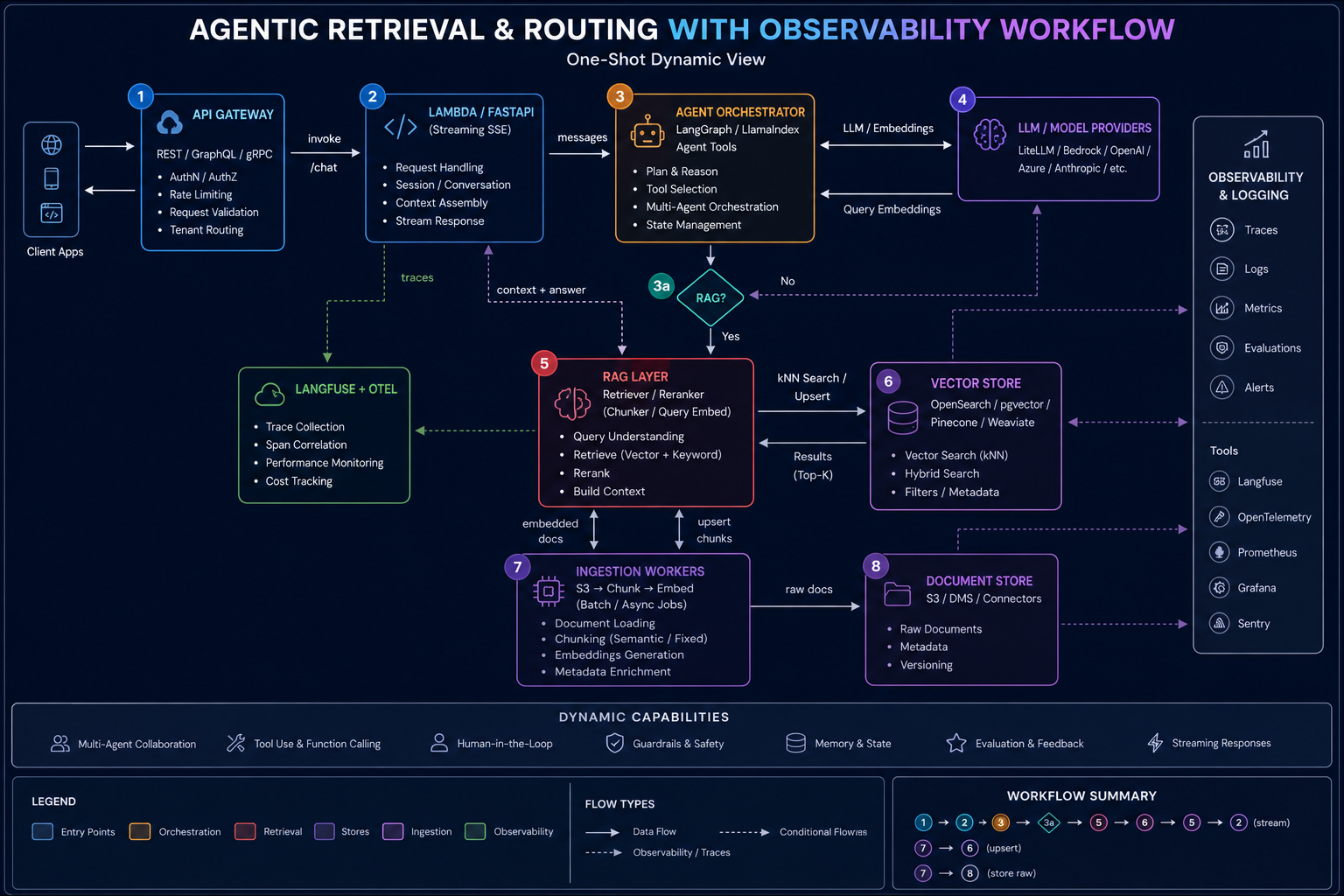
I.O.R.M.G.O.D
Interface & Gateway
Orchestrator / Agent
Retrieval (RAG)
Models
Guardrails
Observability & Eval
load-bearingData & Governance
Getting Started
Get Started in 3 Steps
Name Your Failure Modes
Read 40–100 traces. Group failures into 4–7 categories. This is your failure taxonomy.
30 minBuild Automated Judges
Create deterministic checks or LLM-as-judge evaluators. Set binary pass/fail thresholds. Wire into CI.
1–2 hrsMonitor & Improve
Run evals in production with Langfuse. Sample failures for review. Tune thresholds quarterly.
OngoingReady to Build Your Eval Program?
12-week cohort: failure taxonomy, judge calibration, CI gates, production monitoring, cost optimization.
Agentic AI, Ready for Reality.
Build, evaluate, and improve agentic systems that perform in the real world. From failure taxonomy to production monitoring.
Explore the frameworkStructured Learning
Fundamentals to production.
Hands-on Practice
Templates and frameworks.
Expert Insights
Practitioners in the wild.
Lifetime Access
Always up-to-date.